
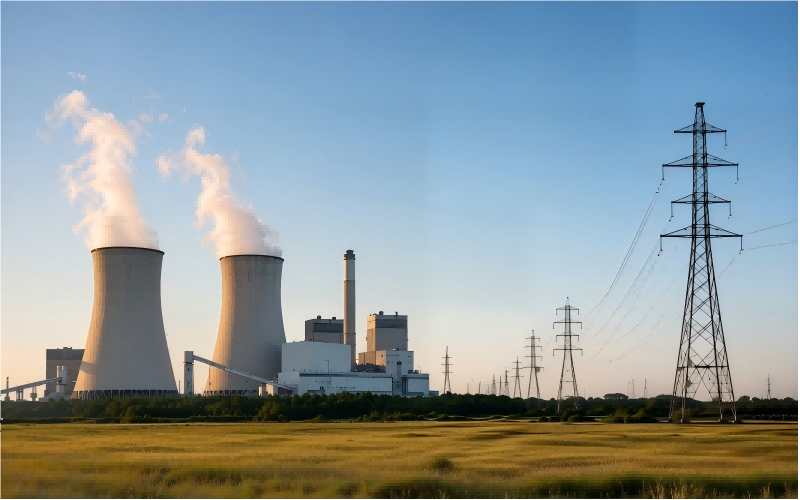
Why Laser Cladding Matters in the Power Generation Industry
Power generation equipment operates under demanding conditions that may include elevated temperatures and pressures, erosion, corrosion, cyclic loading, vibration, and repeated thermal exposure. Components such as boiler tubes, turbine rotor journals, valve sealing surfaces, generator shafts, and other rotating or pressure-bearing parts can gradually suffer wear, dimensional loss, surface damage, or corrosion during long-term service.
Laser cladding provides a localized surface engineering and remanufacturing method for restoring worn areas or adding functional alloy layers to critical components. The process uses a concentrated laser beam to melt the added material together with a thin surface layer of the substrate, creating a metallurgical bond. Because the heat input is localized and controllable, laser cladding can be useful when dimensional stability, coating adhesion, and limited thermal impact are important.
For power plant maintenance and remanufacturing, the process is especially attractive for high-value components where complete replacement would be costly or time-consuming.
Why Laser Cladding Is Suitable for Power Generation Equipment
Power generation components often fail locally rather than uniformly. A boiler tube may suffer severe corrosion or erosion in a specific exposure zone, while a turbine rotor may show localized journal wear and a valve may lose sealing performance only at the seat or sealing surface.
Laser cladding makes it possible to treat these damaged or high-risk areas selectively. Depending on the application, the process can be used to:
· restore worn dimensions;
· create wear-resistant or corrosion-resistant surface layers;
· improve local resistance to erosion and thermal exposure;
· repair high-value components while retaining the original substrate;
· support remanufacturing and service-life extension.
Compared with large-area thermal processes, laser cladding concentrates heat within a controlled zone. This can help reduce the heat-affected region and limit distortion. The metallurgical bond between the deposited layer and the substrate also makes the process suitable for components exposed to repeated mechanical or thermal loading.
Typical Laser Cladding Applications in Power Generation
1. Boiler Tubes and Waterwall Protection
Waste-to-energy boilers and conventional boilers can expose waterwall tubes, superheater tubes, and other heat-exchange surfaces to high-temperature corrosion, ash erosion, and repeated thermal cycling.
In these areas, laser cladding can be used to apply a corrosion- and erosion-resistant alloy layer to selected tube surfaces. The localized heat input helps reduce unnecessary heating of the tube body, while the metallurgically bonded coating provides a durable protective surface.
For maintenance projects, laser cladding can also be used as part of an on-site or workshop repair strategy, depending on access, component condition, and equipment configuration.
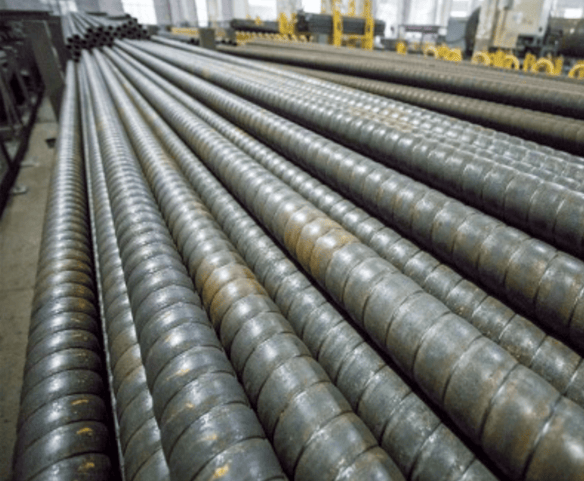
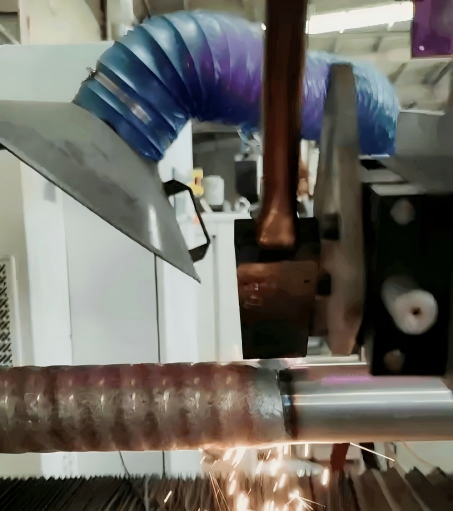
Boiler tube / waterwall laser cladding and representative cladded tube surfaces.
2. Turbine Rotor Journal Repair
Turbine rotor journals can suffer wear, scoring, surface fatigue, or dimensional loss after long-term operation. Because turbine rotors are high-value rotating components, repair methods must carefully control heat input and dimensional change.
Laser cladding can deposit a repair layer only on the damaged journal area. The process can be followed by machining, grinding, or polishing to restore the required diameter and surface finish.
The localized heat input of laser cladding can help reduce the risk of large-scale thermal deformation compared with more extensive welding-based repair methods. Process planning should still consider the rotor material, initial condition, residual stress, deposited alloy, and final dimensional tolerance.
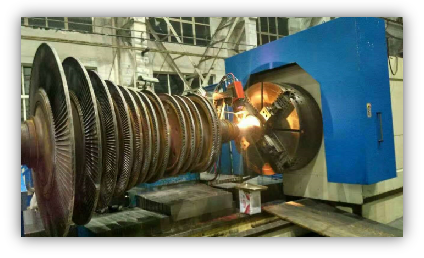
Representative turbine rotor repair / surface restoration application.
3. High-Pressure Valve Sealing Surface Remanufacturing
High-pressure steam valves and safety valves operate under high temperature, pressure, erosion, and repeated opening and closing. Over time, sealing surfaces may experience wear, galling, corrosion, or surface damage that can contribute to leakage.
Laser cladding can be applied to the sealing area to rebuild the surface and add a wear- or corrosion-resistant alloy layer. Cobalt-based and other suitable alloy systems may be selected according to the valve material, service medium, operating temperature, and required surface performance.
After cladding, the sealing surface can be finish-machined or ground to restore its geometry and sealing accuracy. This makes laser cladding a useful remanufacturing option for high-value power plant valves where local surface damage does not justify replacement of the entire component.
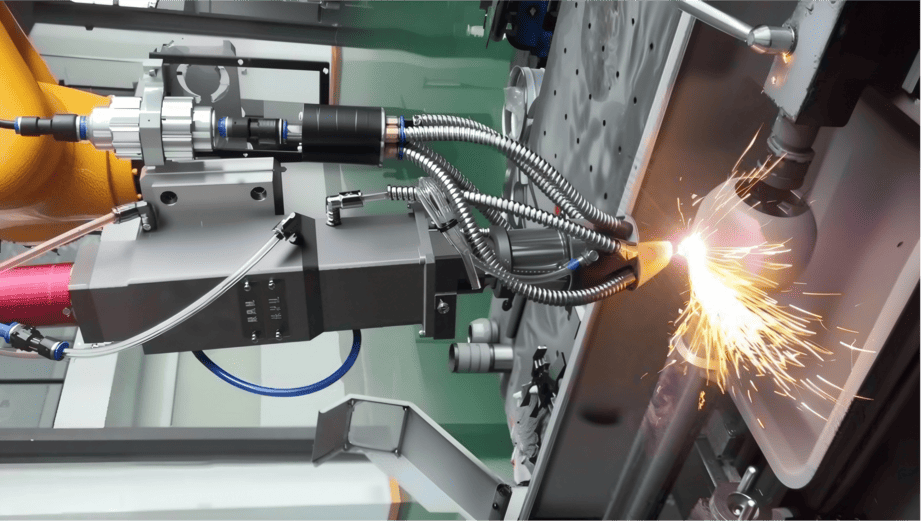
Laser cladding process used for localized surface restoration of a power-industry component.
4. Generator Shafts, Exciter Shafts, and Other Rotating Components
Laser cladding can also be considered for localized journal repair on generator shafts, exciter shafts, and other rotating components. Typical objectives include dimensional restoration, wear resistance, and recovery of functional surfaces after scoring or localized damage.
Because rotating components are sensitive to dimensional accuracy, repair procedures should include suitable inspection, controlled deposition, and final machining. Where necessary, balance and runout should be rechecked after repair.
Laser Cladding vs. Traditional Repair and Coating Methods
Different repair technologies remain useful in the power generation industry, and laser cladding is not a universal replacement for welding, thermal spraying, or electroplating. Its value is strongest when the project requires a combination of localized deposition, metallurgical bonding, controlled heat input, and dimensional restoration.
Compared with conventional weld overlay, laser cladding generally uses a smaller and more concentrated heat source, which can help reduce thermal distortion and dilution under optimized conditions. Compared with thermal spraying, laser cladding forms a metallurgical bond with the substrate rather than relying mainly on mechanical adhesion. Compared with electroplating, laser cladding can build a thicker functional layer and can be used for local dimensional restoration, although the final process choice must still be based on component material, geometry, service environment, coating requirement, and cost.
Key Advantages for Power Plant Maintenance and Remanufacturing
· Localized repair of damaged or high-wear areas;
· Strong metallurgical bonding between the deposited layer and substrate;
· Controlled heat input and a relatively limited heat-affected zone;
· Flexible selection of wear- and corrosion-resistant alloy systems;
· Dimensional restoration followed by finish machining;
· Reduced need to replace an entire high-value component when only a local area is damaged;
· Compatibility with CNC machines, robotic systems, positioners, and customized repair platforms.
The final performance of the cladded layer depends on the substrate, deposited material, process parameters, geometry, preheating requirements, and post-processing route. For critical power generation components, representative process trials and inspection should be completed before production repair.
How LZ Optical Supports Power Generation Applications
LZ Optical provides laser cladding equipment, processing heads, powder feeding systems, optical solutions, and application engineering for industrial repair and remanufacturing.
For power generation projects, the system configuration can be selected according to:
· component type and dimensions;
· substrate material;
· damaged or high-wear area;
· required coating material and target layer thickness;
· required hardness or corrosion resistance;
· available laser power;
· internal or external surface geometry;
· CNC, robot, positioner, or customized motion system;
· workshop or on-site processing conditions.
Typical solutions may include external surface laser cladding, internal bore cladding, wide-beam cladding, robotic laser cladding, and customized processing-head configurations.
FAQ
What power generation components are suitable for laser cladding?
Typical applications include boiler waterwall and superheater tubes, turbine rotor journals, high-pressure valve sealing surfaces, generator shafts, exciter shafts, and other high-value components requiring localized wear, corrosion, or dimensional restoration.
Can laser cladding reduce distortion when repairing turbine rotors?
Laser cladding uses localized and controllable heat input, which can help reduce thermal distortion compared with processes that heat a larger volume of material. The final result still depends on rotor geometry, material, deposition strategy, residual stress, and process parameters.
Is post-processing required after laser cladding?
For dimensional repair applications, machining, grinding, or polishing is usually required after cladding to restore the final geometry, tolerance, and surface finish.
How is the cladding material selected for power plant components?
Material selection depends on the substrate, operating temperature, corrosion or erosion mechanism, wear condition, service medium, and required mechanical properties. Process trials are recommended before finalizing the production solution.