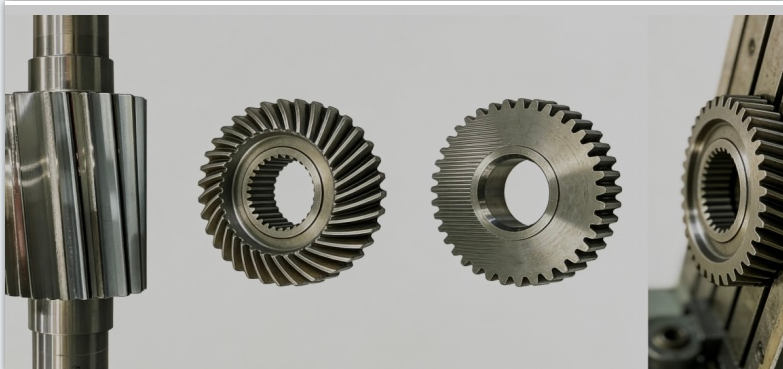
I. Current Status of the Industry and Workpieces
As a core component of mechanical transmission systems, gears directly determine the overall reliability and service life of high-end equipment and are widely used in many strategic emerging industries such as new energy vehicles, industrial robots, aerospace, and construction machinery.
From the perspective of the workpiece itself, gears must withstand alternating loads, intense friction, and impact during high-speed meshing, making them prone to failure phenomena such as fatigue pitting, scuffing, and tooth breakage. Their surface hardness, wear resistance, and fatigue strength directly determine their service life. Traditional gear materials often use 45# steel, 40Cr, and 20CrMnTi, etc. After traditional quenching treatment, it is difficult to balance surface hardness and matrix toughness, and problems such as deformation and uneven hardened layer thickness are easily generated . Furthermore, with the development of new energy vehicles towards lightweight and high efficiency, the precision and fatigue resistance requirements for gears in fields such as robotics and aerospace are becoming increasingly stringent. Traditional processes can no longer meet the industry's development needs, and there is an urgent need for new surface strengthening technologies to achieve upgrades and iterations.
II. Comparison of the technical advantages of laser quenching and high-frequency quenching
1. The pain points of traditional quenching
Traditional quenching is currently the mainstream process for gear processing, such as high/medium frequency quenching. This involves rapidly heating the gear surface and then cooling it with water/oil. While it offers advantages such as fast heating speed and high efficiency, it also has significant limitations:
l Deformation control is difficult: the heating range is large and the heat-affected zone is wide ( 1-5mm ). The gear is heated unevenly as a whole, and the deformation after quenching reaches 0.3-1mm . Subsequent secondary processing such as gear grinding and straightening is required, which not only increases the process cost, but also easily damages the precision of the tooth surface.
l Poor adaptability: Special tooling needs to be customized for different modules and tooth profiles, resulting in low versatility; complex gear structures (such as internal gears and small module gears) cannot achieve uniform heating, which can easily lead to problems such as overheating of the tooth tip and insufficient hardening of the tooth root.
l Insufficient performance stability: The depth of the hardened layer fluctuates greatly ( 0.5-3mm ), the hardness uniformity is poor, and soft spots are easily generated;
l Environmental protection: It requires water/oil cooling medium, which generates wastewater and waste liquid, and subsequent treatment costs are required, causing environmental pollution; laser quenching does not require cooling medium and is a clean and fast quenching process. In contrast, traditional quenching does not meet green production standards at all.
2. Characteristics of laser quenching
Laser hardening is a solid-state phase transformation strengthening process that utilizes a high-energy-density laser beam (power density 10³-10⁶ W/cm²) to rapidly scan the surface of a gear, instantly heating it to its austenitizing temperature (800-1200℃). The heat is then conducted through the matrix itself to achieve self-cooling hardening, ultimately forming a dense martensitic hardened layer. Compared to traditional hardening, laser hardening offers revolutionary advantages in four key areas: precision, performance, adaptability, and environmental friendliness. A detailed comparison follows:
Quenching precision and deformation control: The laser beam of laser quenching can be focused to a precision of 0.1mm. By planning the scanning path through computer modeling, it can accurately fit complex curved surfaces such as tooth surface and tooth root, and achieve local selective strengthening. The heat-affected zone is only 0.3-1mm, and the deformation can be controlled within 0.1mm. The surface roughness of the tooth remains basically unchanged after quenching, and no subsequent grinding is required.
Hardened layer quality and performance: The hardened layer formed by laser quenching is uniform and dense, with a high-hardness martensite surface. The surface hardness can reach HRC58~64 (taking 42CrMo material as an example), which is 4~8 HRC higher than that of traditional quenching (HRC50~60). Moreover, the hardness gradient is uniform, and the fatigue strength is significantly improved compared with traditional processes.
Adaptability and flexibility: Laser hardening can be adapted to various complex tooth profiles such as spur gears, helical gears, bevel gears, and worm gears. It does not require customized special tooling and can precisely strengthen key parts of gears (such as tooth surfaces and tooth roots). It can flexibly meet the flexible production needs of small batches and multiple varieties. At the same time, it can process large precision gear rings with a diameter of more than 3000mm, filling the technical gap of traditional processes.
Environmental friendliness and energy efficiency: Laser quenching requires no cooling media such as water or oil, and produces no wastewater or exhaust gas emissions, making it a green and environmentally friendly process. Moreover, its energy consumption is far lower than that of high-frequency quenching.
III. Cost Differences
Laser hardening offers significant advantages over traditional hardening processes in specific scenarios, particularly in terms of equipment, labor, energy consumption, and long-term costs. It also boasts superior performance in subsequent processing. Laser-hardened gears exhibit minimal deformation, eliminating the need for subsequent grinding and other finishing processes; simple polishing suffices, reducing subsequent processing costs by over 60%. In contrast, traditional hardening methods result in substantial gear deformation, necessitating grinding and, in some cases, tempering. These processes are not only time-consuming but also significantly increase subsequent processing costs. In conclusion, with the upgrading of high-end equipment manufacturing, laser hardening technology for gears, with its advantages of high precision, minimal deformation, superior performance, environmental friendliness, energy efficiency, and low long-term costs, is gradually replacing traditional hardening processes and becoming the mainstream technology for gear surface strengthening. In the future, with the integration of laser technology with artificial intelligence and digital technologies, laser hardening for gears will evolve towards automation, intelligence, and integration, further improving processing efficiency and quality, contributing to the localization of high-end gears, and promoting the independent and controllable development of the equipment manufacturing industry .