
In chemical processing, petrochemical production, and equipment handling highly corrosive media, pressure vessels must provide both structural strength and corrosion resistance. Rather than manufacturing the entire vessel from high-alloy material, a long-established engineering approach is to use carbon steel or low-alloy steel for the load-bearing structure and apply a corrosion-resistant cladding layer to the internal surface. Published literature shows that stainless steel and nickel-alloy weld overlays are widely used on pressure vessels and piping internals. Submerged arc strip cladding (SASC) and electroslag strip cladding (ESSC) remain mature methods for large-area overlay because of their wide coverage and high deposition rates.
However, when a project requires lower dilution, a thinner corrosion-resistant layer, lower heat input, and less finish machining, the process window of conventional high-heat-input weld overlay becomes more restrictive. Laser cladding, also known as laser metal deposition, uses a highly concentrated heat source to create a metallurgical bond between the deposited material and the substrate, while enabling low dilution, a small heat-affected zone, and precise heat-input control. For pressure vessel internal wall cladding, this makes laser technology more than simply another overlay process; it can serve as a process upgrade for high-value corrosion resistant cladding.
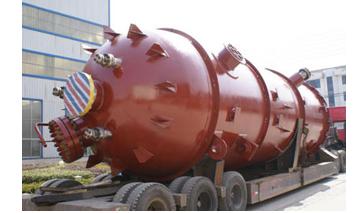
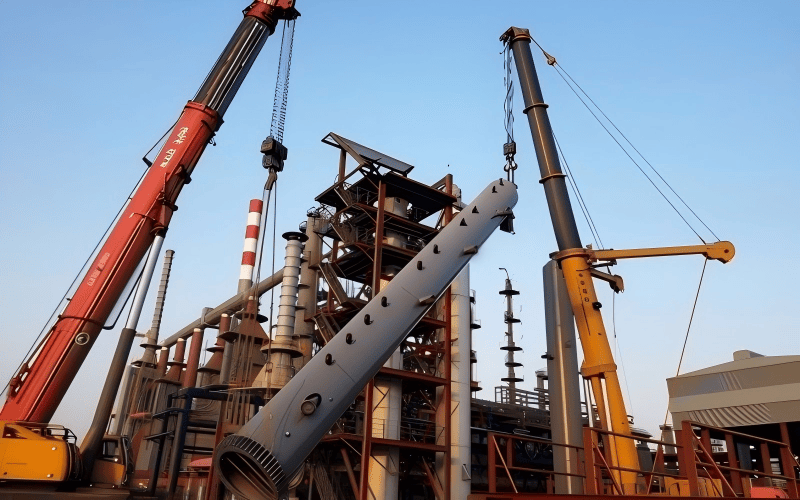
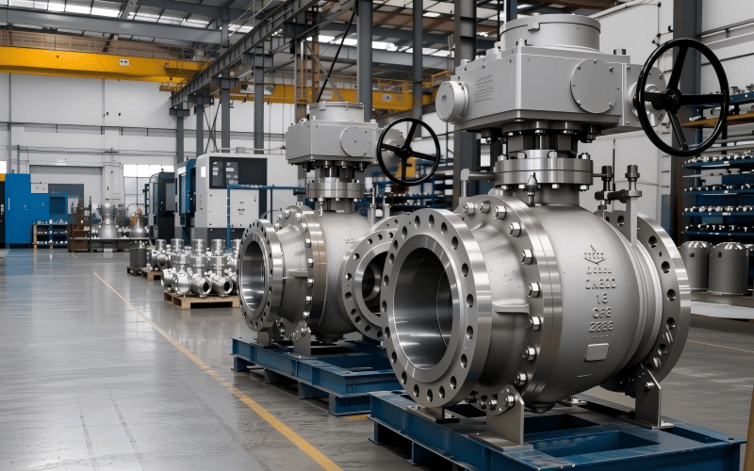
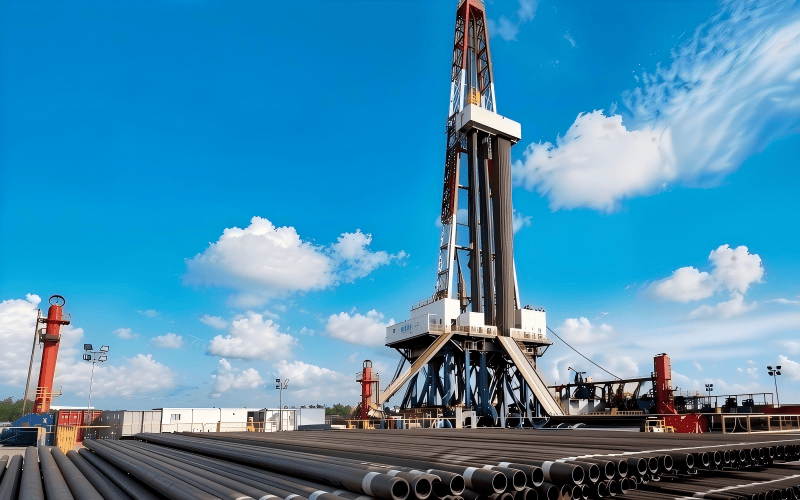
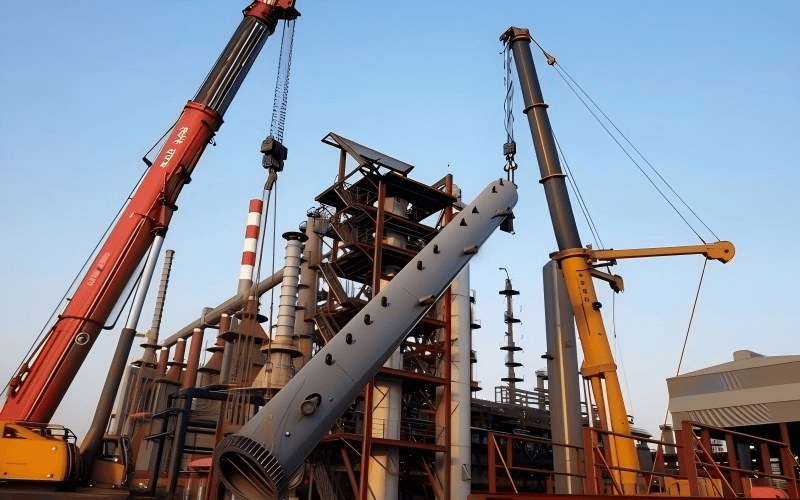
Large pressure vessel - illustrative product Chemical pressure vessel - product photograph Pressure vessel installation at site
1. Conventional Weld Overlay vs. Laser Cladding: The Real Comparison Is Final Cladding Quality
For large-diameter, long-shell pressure vessels, traditional submerged arc or electroslag strip cladding offers clear advantages: mature equipment, high deposition rates, and strong suitability for thick overlays and continuous large-area production. Laser cladding should therefore not replace conventional processes in every application. A more meaningful comparison is which method can achieve the same final corrosion-resistance target with less high-alloy material, lower substrate dilution, and less post-processing.
Comparison Criteria | Conventional SASC / ESSC / Arc Weld Overlay | Wide-Beam Laser Cladding |
Heat Input | Higher total heat input and a larger heated area in the substrate | Concentrated heat source enables lower overall heat input and a smaller heat-affected zone |
Dilution Control | Dilution can be reduced through strip width, layer count, and parameter optimization, but very low dilution often requires multiple layers or stricter process control | Laser cladding is inherently low in dilution, making it easier to limit the pickup of substrate elements |
Cladding Thickness | To achieve the required final surface chemistry, a larger deposited thickness and machining allowance are often reserved | For the same dilution or surface-chemistry target, the required cladding thickness may be reduced, subject to procedure qualification |
As-Clad Surface | Bead profiles and overlap patterns are pronounced, and larger turning or grinding allowances are often required | A wide rectangular beam reduces the number of tracks and overlap zones, producing a more uniform and flatter surface |
Alloy Consumption | Thicker overlays increase the consumption of stainless steel or nickel alloy | Thinner layers can reduce the consumption of high-value materials such as Ni625 |
Best-Fit Applications | High deposition rate, thick layers, and mature large-area manufacturing | Low dilution, thin layers, low heat input, high surface consistency, and material savings for expensive alloys |
2. Stainless Steel Internal Wall Cladding: Thinner and Flatter at a Comparable Dilution Target
For pressure vessels that use stainless steel as the corrosion-resistant layer, the key question is usually not whether the material can be deposited, but how to maintain metallurgical bonding and the required final chemical composition while minimizing substrate dilution, distortion, and finish machining. The low-dilution characteristics of pressure vessel laser cladding allow the design approach to shift from "using extra thickness to compensate for dilution" to "controlling composition through precise heat input." In our current process trials, laser cladding achieved a thinner effective layer at a comparable dilution-control target, reducing stainless steel consumption and machining allowance.
For large internal areas of pressure vessels, we use a wide rectangular beam. The current maximum beam width is approximately 26 mm and may be extended toward 60 mm or wider, depending on laser power, focal length, optical design, and process stability. Compared with overlapping many passes made with a small circular spot, the wide beam reduces the number of scan tracks and overlaps per unit area, lowers surface-height variation, and supports more efficient finish machining. Published research has also demonstrated low-dilution, wide-track laser deposition on steel substrates, providing a technical basis for large-area internal wall laser cladding.
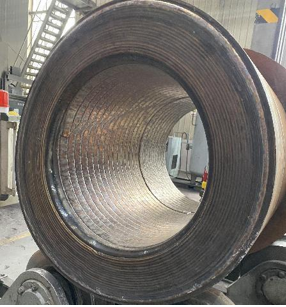
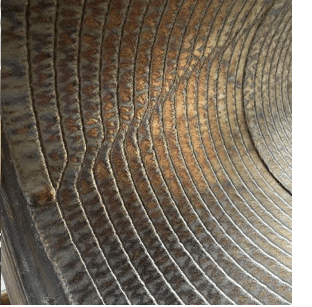
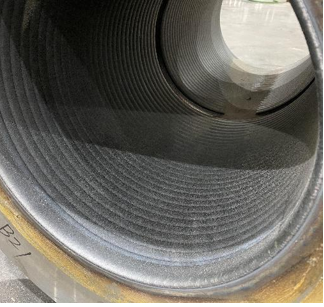
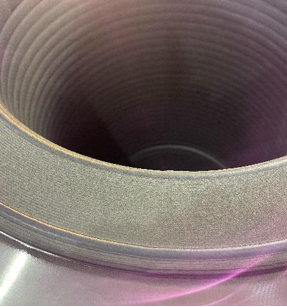
Conventional submerged arc weld Conventional submerged arc weld Laser-clad internal wall (overall view) Laser-clad internal wall (detail)
overlay on an internal wall (overall view) overlay on an internal wall (detail)
Visible Differences in the As-Clad Surface
Individual bead profiles and overlap textures are more pronounced on conventional weld overlays, while wide-beam laser-clad surfaces appear more continuous and uniform. For pressure vessels that require finish machining or have strict requirements for effective cladding thickness, this surface-profile difference directly affects machining allowance, alloy consumption, and manufacturing cycle time
3. Ni625 / Alloy 625 Laser Cladding: Using Fe Dilution as a Key Process Indicator
When service conditions become more corrosive, such as chloride-bearing environments, acidic media, localized corrosion, or more severe combinations of temperature and pressure, Ni625 (Alloy 625 / UNS N06625) is a widely used nickel-chromium-molybdenum-niobium corrosion-resistant alloy. The Alloy 625 technical data published by Special Metals lists typical composition ranges of Ni ≥ 58%, Cr 20-23%, and Mo 8-10%, with Fe ≤ 5%. The alloy is widely used in chemical processing equipment, reaction vessels, heat exchangers, piping, and valves.
It is important to distinguish the Fe content of the powder or filler metal from the Fe content measured at the clad surface. During Ni625 laser cladding on carbon steel or low-alloy steel, substrate melting introduces additional Fe into the melt pool. Surface Fe can therefore serve as a practical indicator of substrate dilution. Published studies report that increasing Fe content in laser-clad Ni625 can reduce high-temperature corrosion resistance. One study on 20# carbon steel recommended controlling Fe dilution below 5 wt.% under its test conditions, while another study on the corrosion behavior of laser-clad Ni625 also found that dilution significantly affects final corrosion performance.
In our process trials for pressure vessel internal wall cladding, Ni625 laser cladding has achieved surface Fe below 1 wt.% relatively readily. The significance is not simply a lower number. It indicates that very low substrate dilution can be maintained while reducing the thickness of expensive nickel-alloy material required to reach the target surface composition. For large pressure vessel interiors, the material-saving effect increases rapidly with the total cladded area.
Indicator | Why It Matters | Project Recommendation |
Surface Fe Content | One indicator of substrate dilution in a Ni625 layer; excessive Fe relatively reduces the effective concentrations of Ni, Cr, Mo, and other alloying elements | Define the measurement location, surface-removal depth, and target value during procedure qualification. Current in-house testing has achieved < 1 wt.% |
Effective Cladding Thickness | Affects corrosion life, material cost, and post-machining requirements | Do not compare only the total as-deposited thickness. Compare the effective thickness after the required final composition has been achieved |
Measurement Method | EDS, XRF, and OES differ in measurement depth and quantitative accuracy | Agree on the method and acceptance criteria in advance. Avoid directly comparing results obtained with different instruments |
Corrosion Verification | Fe is an important process indicator, but it is not the sole criterion for corrosion performance | Specify chemical analysis, PT/UT, metallography, and any necessary corrosion tests according to the service medium and applicable specification |
4. Why Does a Wide Rectangular Beam Matter for Large Pressure Vessels?
The internal surface of a pressure vessel differs from a conventional shaft-type component: the area is large, continuous processing times are long, and overlap consistency and path planning are more demanding. In this application, increasing laser power alone does not automatically improve final productivity. Engineering feasibility depends on how wide, flat, and low in dilution each scan track can be produced consistently.
• Reduce overlap passes: A wider beam requires fewer tracks over the same area, reducing surface waviness created by overlap zones.
• Improve large-area coverage: When laser power and powder-feed capacity are properly matched, a wide beam is better suited to continuous cladding of long shells and large-diameter internal surfaces.
• Reduce finish-machining demand: A flatter as-clad surface means less turning, grinding, or polishing allowance.
• Use high-value alloys more efficiently: Nickel-alloy powders such as Ni625 are expensive. Avoiding unnecessary thickness and excessive overlap directly reduces material cost.
• Support automation: Combined with vessel rotation, linear axes, robots, or dedicated internal-cladding mechanisms, the process can maintain a stable focal distance, overlap ratio, and toolpath.
5. Which Chemical Pressure Vessels Should Be Prioritized for Laser Cladding?
From both economic and technical perspectives, the strongest candidates for pressure vessel laser cladding are not all vessels, but projects where the cladding alloy is expensive, dilution limits are strict, the internal surface area is large, or conventional overlays must be relatively thick. Typical candidates include:
• Corrosion-resistant stainless steel cladding on large-diameter internal surfaces of reactors, separators, columns, and storage tanks;
• Internal walls exposed to chlorides, acidic media, or localized corrosion and therefore requiring Ni625 / Alloy 625;
• Projects seeking to reduce nickel-alloy consumption through a thinner layer while maintaining low dilution and the required final surface chemistry;
• High-value equipment with strict limits on heat input, distortion, heat-affected zone, or finish-machining allowance;
• Projects that currently require extensive machining after conventional weld overlay and could benefit from a flatter as-clad surface and a shorter finishing cycle.
6. Eight Parameters to Evaluate When Selecting the Cladding Process
To avoid comparing only cladding speed or single-layer thickness, translate the final acceptance criteria into process inputs at an early project stage. At minimum, confirm the following information:
• 1) Pressure vessel substrate grade and its welding or post-weld heat treatment (PWHT) requirements;
• 2) Vessel internal diameter, length, access-opening dimensions, and cladding-head reach;
• 3) Target cladding material: stainless steels such as 308L, 309L, or 316L, or nickel alloys such as Ni625;
• 4) Required final effective cladding thickness, rather than only the as-deposited height;
• 5) Permitted substrate dilution or limits for key surface elements such as Fe;
• 6) Target surface roughness, machining allowance, and whether finish machining is required;
• 7) Requirements for nondestructive testing, chemical analysis, metallography, hardness, and corrosion testing;
• 8) On-site or factory processing conditions, including orientation, preheating, shielding gas, powder recovery, and automation method.
7. Should Laser Cladding Completely Replace Submerged Arc Weld Overlay?
No. For projects requiring thick overlays, extremely large areas, and the highest possible deposition rate, conventional SASC and ESSC still offer strong cost and production-capacity advantages. Laser cladding is better suited to a different objective: when the customer prioritizes low dilution, a thin effective layer, Ni625 material savings, low heat input, and better surface consistency, the laser process can optimize these targets within one process window.
For chemical pressure vessels, the most practical approach is therefore not to ask whether laser cladding or submerged arc overlay is "more advanced." The cladding method should be selected according to the service medium, required corrosion-resistance level, Fe or dilution limit, effective thickness, and total manufacturing cost.
Frequently Asked Questions (FAQ)
Q1: What materials can be used for pressure vessel internal wall laser cladding?
Common options include austenitic stainless steels and nickel-based corrosion-resistant alloys such as Ni625. The final alloy should be selected according to the service medium, temperature, pressure, and customer specification.
Q2: Why is Fe content important in a Ni625 cladding layer?
When cladding is applied to a steel substrate, most of the additional Fe comes from substrate melting. Higher surface Fe generally indicates greater substrate dilution, so it is an important process-quality indicator. However, it should not replace project-specific corrosion testing or a complete chemical analysis.
Q3: Can Ni625 laser cladding achieve surface Fe below 1%?
Yes, this has been achieved in our current process trials. Actual results depend on the substrate, cladding thickness, beam shape, laser power, travel speed, powder-feed rate, overlap ratio, and measurement method. A formal project should confirm the target through procedure qualification.
Q4: How wide can the rectangular laser beam be?
The current solution provides a maximum width of approximately 26 mm. Depending on laser power and optical design, it can be developed toward 60 mm or wider. The purpose of a wider beam is to reduce the number of tracks and overlaps, not simply to maximize the beam dimension.
Q5: What is the main economic value of laser cladding?
For large-area Ni625 or other high-value alloy cladding, the value usually comes from the combined benefits of reducing unnecessary deposited thickness, lowering finish-machining requirements, controlling dilution, and reducing heat input, rather than simply comparing kilograms deposited per hour.